
For "mids" collection objects, ggmid() visualizes and compares one or more main effects across multiple models.
Usage
# S3 method for class 'mids'
ggmid(
  object,
  terms = term.labels(object, order = 1L),
  type = c("effect", "series"),
  theme = NULL,
  intercept = FALSE,
  limits = c(NA, NA),
  resolution = NULL,
  labels = NULL,
  ...
)

# S3 method for class 'mids'
autoplot(object, ...)
Arguments
- object
a "mids" collection object to be visualized.
- terms
a character vector or a formula specifying the component functions to be plotted. If a formula is provided (e.g.,
~ x + y), it is automatically parsed to extract the relevant terms.- type
the plotting style: "effect" plots the effect curve per model, while "series" plots the effect trend over models per feature value.
- theme
a character string or object defining the color theme. See
color.themefor details.- intercept
logical. If
TRUE, the model intercept is added to the component effect.- limits
a numeric vector of length two specifying the limits of the plotting scale.
NAvalues are replaced by the minimum and/or maximum MID values.- resolution
an integer specifying the number of evaluation points for continuous variables.
- labels
an optional numeric or character vector to specify the model labels. Defaults to
labels(object). The function attempts to parse these labels into numeric values where possible.- ...
optional parameters passed to the main layer (e.g.,
linewidth,alpha).
Value
ggmid.mids() returns a "ggplot" object if a single main effect is specified, or a list of "ggplot" objects if multiple main effects are specified.
Details
This is an S3 method for the ggmid() generic that evaluates the specified term over a grid of values and compares the results across all models in the collection.
The type argument controls the visualization style.
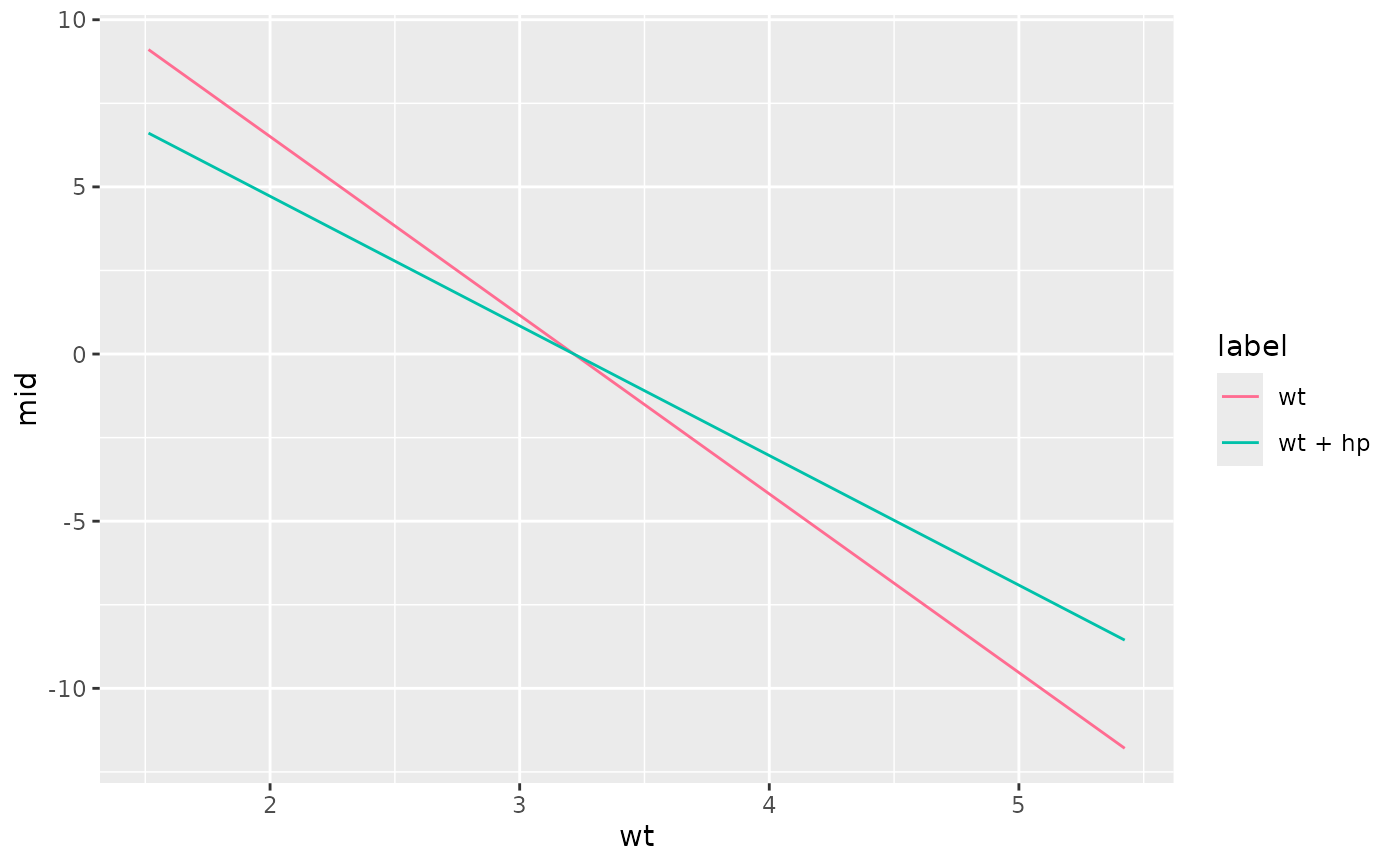
The default, type = "effect", plots the component functions of the specified term for each model individually.
The type = "series" option transposes the view to plot the effect trend over the models for each feature value.
Note: Comparative plotting for interaction terms (2D surfaces) is not supported for collection objects.
Examples
# Use a lightweight dataset for fast execution
data(mtcars, package = "datasets")
# Fit two models with different complexities
fit1 <- lm(mpg ~ wt, data = mtcars)
mid1 <- interpret(mpg ~ wt, data = mtcars, model = fit1)
fit2 <- lm(mpg ~ wt + hp, data = mtcars)
mid2 <- interpret(mpg ~ wt + hp, data = mtcars, model = fit2)
# Combine them into a "midlist" collection (which inherits from "mids")
mids <- midlist("wt" = mid1, "wt + hp" = mid2)
# Compare the main effect of 'wt' across both models
ggmid(mids, term = "wt")
 # Compare the effect of 'wt' as a series plot across the models
ggmid(mids, term = "wt", type = "series")
# Compare the effect of 'wt' as a series plot across the models
ggmid(mids, term = "wt", type = "series")
