term.effect() calculates the contribution of a single component function of a fitted additive models.
It serves as a low-level helper function for making predictions or for direct analysis of a term effect.
term.f() is a convenient shorthand for term.effect().
Usage
term.effect(object, ...)

# S3 method for class 'mid'
term.effect(object, term, x, y = NULL, ...)

# S3 method for class 'mids'
term.effect(object, term, x, y = NULL, ...)

# Default S3 method
term.effect(object, term, x, y = NULL, data = NULL, ...)

term.f(object, ...)
Arguments
- object
a "mid" object, a collection of models ("mids"), or other compatible additive model objects (e.g., "lm", "glm").
- ...
optional arguments to be passed to methods.
- term
a character string specifying the component function (term) to evaluate.
- x
a vector of values for the first variable in the term. If a matrix or data frame is provided, values of the related variables are automatically extracted from it.
- y
a vector of values for the second variable in an interaction term. Ignored if
xis a data frame containing both variables.- data
an optional data frame containing the original training data. Required for additive models if the data cannot be automatically extracted from the model object.
Value
term.effect() returns a numeric vector of the calculated term contributions, with the same length as x.
For a collection of models ("mids"), term.effect() returns a numeric matrix where each column corresponds to a model.
Details
term.effect() is a low-level S3 generic function designed to calculate the contribution of a single component function.
Unlike predict.mid(), which is designed to return total model predictions, term.effect() is more flexible.
It accepts vectors, as well as matrices or data frames, as input for x and y. If x is a data frame, the necessary columns are automatically extracted.
This makes it particularly useful for visualizing a component's effect in combination with standard plotting functions, such as graphics::curve().
For a main effect, the function evaluates the component function \(f_j(x_j)\) for a vector of values \(x_j\).
For an interaction, it evaluates \(f_{jk}(x_j, x_k)\) using vectors \(x_j\) and \(x_k\).
The assignment of x and y strictly follows the order of variables specified in the term argument.
For example, if term = "Temp:Wind", x is assigned to Temp and y is assigned to Wind.
Examples
data(airquality, package = "datasets")
mid <- interpret(Ozone ~ .^2, data = airquality, lambda = 1)
#> 'model' not passed: response variable in 'data' is used
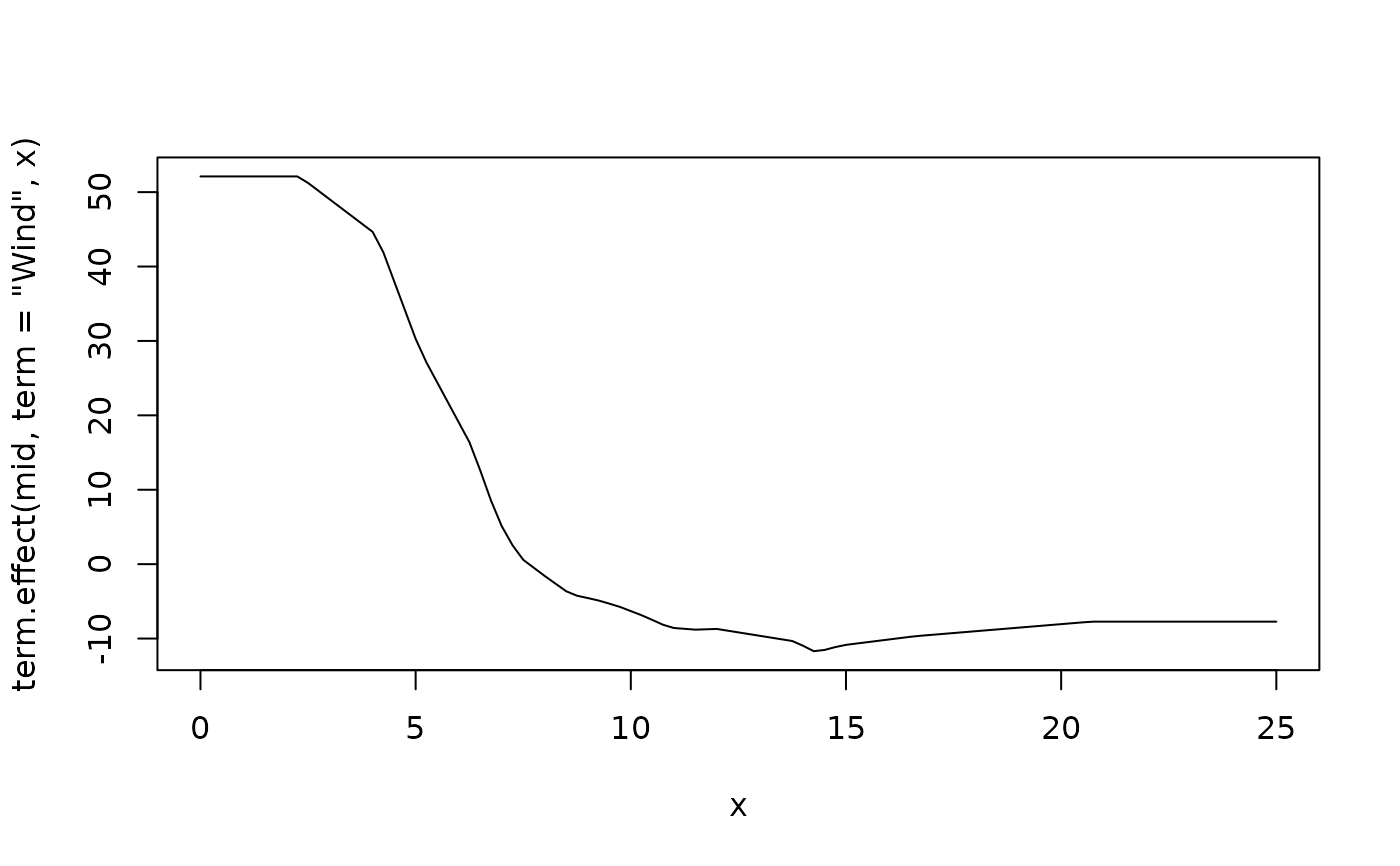
# Visualize the main effect of "Wind"
curve(term.effect(mid, term = "Wind", x), from = 0, to = 25)
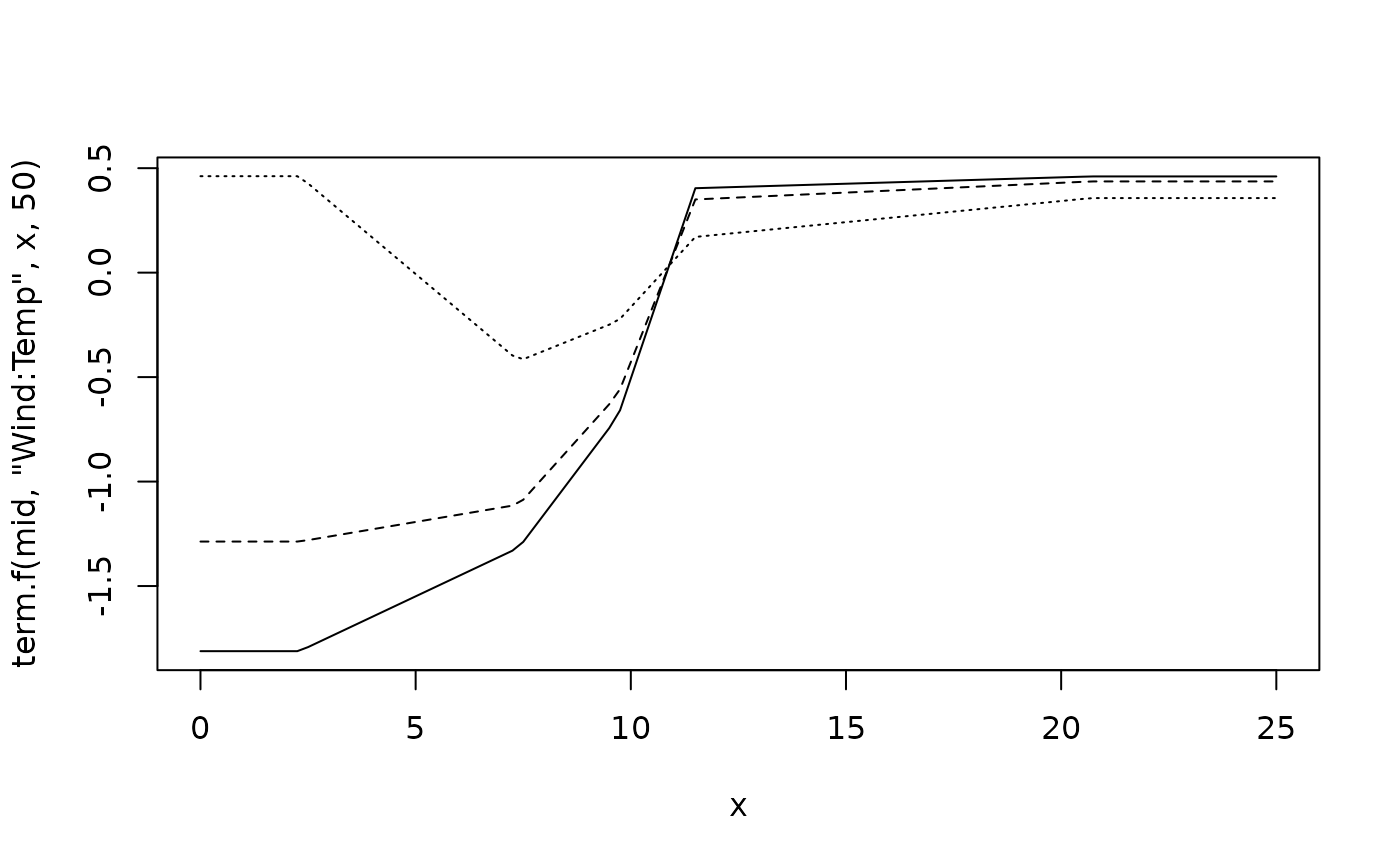
 # Visualize the interaction of "Wind" and "Temp"
curve(term.f(mid, "Wind:Temp", x, 50), 0, 25)
curve(term.f(mid, "Wind:Temp", x, 60), 0, 25, add = TRUE, lty = 2)
curve(term.f(mid, "Wind:Temp", x, 70), 0, 25, add = TRUE, lty = 3)