パッケージの概要
機械学習におけるRandomForestモデルを構築できます。RandomForestモデルとは、多数の決定木を集めてそれらの予測値よりモデル全体の予測値を算出する、アンサンブルモデルの一種です。
使用例:irisデータの分類
irisデータを用いて、がく弁・花弁の長さ・幅の情報からアヤメの種類を特定するRandomForestモデルをrandomForestパッケージを用いて構築します。
irisデータセットを読み込む
irisデータを読み込み、データの先頭を表示します。
Sepal.Length:がく弁の長さ
Sepal.Width:がく弁の幅
Petal.Length:花弁の長さ
Petal.Width:花弁の幅
アヤメの種類はsetosa(1)、versicolor(2)、virginica(3)の3種類です。
  Sepal.Length Sepal.Width Petal.Length Petal.Width Species
1          5.1         3.5          1.4         0.2  setosa
2          4.9         3.0          1.4         0.2  setosa
3          4.7         3.2          1.3         0.2  setosa
4          4.6         3.1          1.5         0.2  setosa
5          5.0         3.6          1.4         0.2  setosa
6          5.4         3.9          1.7         0.4  setosa
irisデータの構造
irisデータの各種構造を確認します。
'data.frame':   150 obs. of  5 variables:
 $ Sepal.Length: num  5.1 4.9 4.7 4.6 5 5.4 4.6 5 4.4 4.9 ...
 $ Sepal.Width : num  3.5 3 3.2 3.1 3.6 3.9 3.4 3.4 2.9 3.1 ...
 $ Petal.Length: num  1.4 1.4 1.3 1.5 1.4 1.7 1.4 1.5 1.4 1.5 ...
 $ Petal.Width : num  0.2 0.2 0.2 0.2 0.2 0.4 0.3 0.2 0.2 0.1 ...
 $ Species     : Factor w/ 3 levels "setosa","versicolor",..: 1 1 1 1 1 1 1 1 1 1 ...
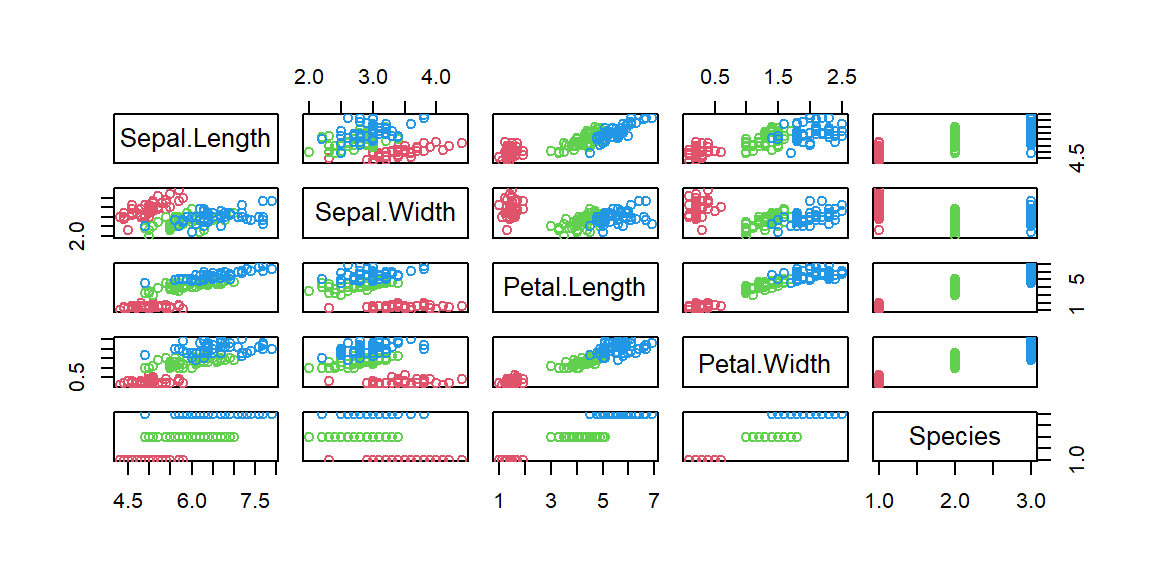
また、データを散布図にプロットして確認します。
plot (iris, col= c (2 , 3 , 4 )[iris$ Species])
モデル構築1(全体データ)
まずは全てのデータを使ってRandomForestモデルを構築してみます。
Type rfNews() to see new features/changes/bug fixes.
# シードを設定 set.seed (123 ) <- randomForest (Species ~ ., data = iris))
Call:
 randomForest(formula = Species ~ ., data = iris)
               Type of random forest: classification
                     Number of trees: 500
No. of variables tried at each split: 2

        OOB estimate of  error rate: 4.67%
Confusion matrix:
           setosa versicolor virginica class.error
setosa         50          0         0        0.00
versicolor      0         47         3        0.06
virginica       0          4        46        0.08
重要度の確認
データの各特徴量の重要度を確認することが出来ます。irisデータの分類には花弁の長さ(Petal.Length)・花弁の幅(Petal.Width)の情報が重要であることが分かります。
             MeanDecreaseGini
Sepal.Length         9.659149
Sepal.Width          2.204130
Petal.Length        44.244822
Petal.Width         43.081313
モデル構築2(訓練データとテストデータに分割)
irisデータをモデル生成のための訓練データと、モデル評価のためのテストデータに分割します。データ割合は訓練データを7割、テストデータを3割とします。確認のため、データサイズを出力します。
# シードを設定 set.seed (123 ) # データの分割 <- sample (1 : nrow (iris), 0.7 * nrow (iris)) <- iris[sample_indices, ]<- iris[- sample_indices, ]# データサイズの確認 c (nrow (iris), nrow (df.train), nrow (df.test))
モデル生成
訓練データを用いてRandomForestモデルを生成します。
# シードを設定 set.seed (123 )<- randomForest (Species ~ ., data = df.train))
Call:
 randomForest(formula = Species ~ ., data = df.train)
               Type of random forest: classification
                     Number of trees: 500
No. of variables tried at each split: 2

        OOB estimate of  error rate: 5.71%
Confusion matrix:
           setosa versicolor virginica class.error
setosa         36          0         0  0.00000000
versicolor      0         29         3  0.09375000
virginica       0          3        34  0.08108108
モデル評価
テストデータを使ってモデル評価を行います。まずはテストデータを元に生成したモデルを用いて予測結果を算出します。
<- predict (model.rf, df.test)
予測結果とテストデータのもともとのアヤメの分類とを比較します。おおむね正しく分類できていることが分かります。
<- table (prediction, df.test$ Species))
prediction   setosa versicolor virginica
  setosa         14          0         0
  versicolor      0         17         0
  virginica       0          1        13
<- sum (diag (result)) / sum (result))
ハイパーパラメーターのチューニング
RandomForestの主なハイパーパラメーターは以下の通りです。
決定木を生成する際に使用するパラメータの数(mtry)
生成する決定木の数(ntree)
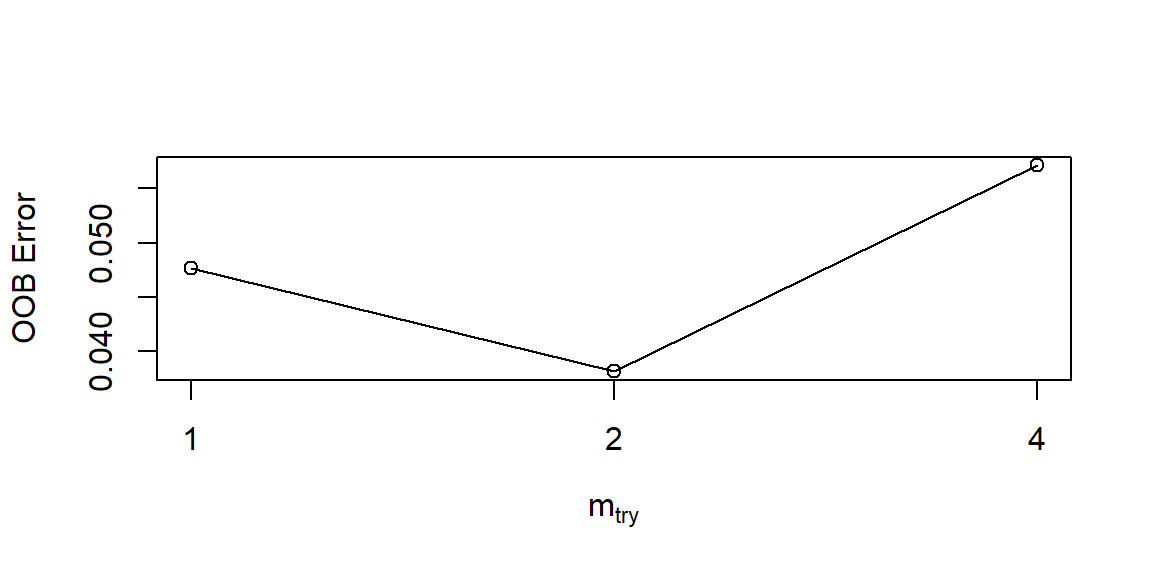
これらのハイパーパラメータの最適な設定を探す作業がハイパーパラメーターのチューニングとなります。 まずはmtryの最適な設定を確認します。これはrandomForestパッケージのtuneRF関数で実行できます。
set.seed (123 )<- tuneRF (df.train[, - 5 ], df.train[, 5 ], doBest = TRUE )
mtry = 2  OOB error = 3.81%
Searching left ...
mtry = 1    OOB error = 4.76%
-0.25 0.05
Searching right ...
mtry = 4    OOB error = 5.71%
-0.5 0.05
OOB Error(誤識別率)が最も低くなるmtryは2であることが分かりました。
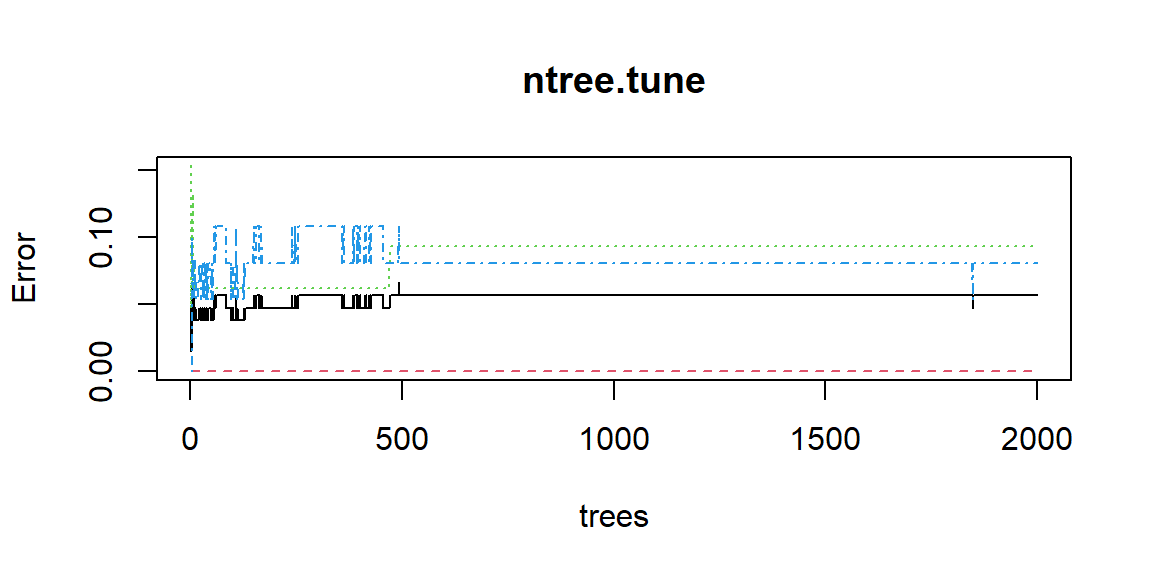
次に、ntreeのチューニングを行います。これは十分大きなntreeでモデルを作成した後に、 木の数ごとのOOB Errorを出力させて確認します。
set.seed (123 )<- randomForest (Species ~ ., data = df.train, mtry = 2 , ntree = 2000 )plot (ntree.tune)
4つの誤識別率のグラフが現れていますが、黒:全体、赤:setosa、緑:versicolor、青:virginicaの誤識別率となります。 ntreeが500程度で誤識別率がほぼ横ばいとなるため、ntreeは500程度の設定が良さそうであることが分かりました。
なお、ここで得られたmtry = 2, ntree = 500の設定は、「モデル生成」の際に作成されたモデルの設定と同じです。